The Hydraulic Car
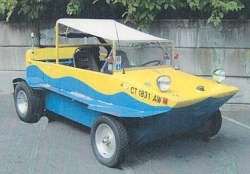
The Hydraulic Car. At last, a superb example of an amphibious car using a hydraulic control system. This car is really crazy and exudes fun, just as they should do. It is only when you look at it carefully that you can see just how amazing the build quality has been.
This is the only amphibious car we have ever come across with hydraulic controls and that is surprising, because this is the first type of system we would consider when trying to provide drive to both propellers and wheels.
Paul (the builder) says he never had the chance to examine an amphibious car but simply got "fired up" after seeing a video of an "Amphicar".
So what do you get when you mix thousands of hours of build time, an experienced racing car builder, the mighty 2300cc engine lump from a Mustang, many thousands of dollars and the hydraulic parts of an excavator?
The answer is a great amphibious fun car that Paul took on parades in his home town of Norwalk, Connecticut.
Hydraulics are normally used to convert high rev power from a low powered engine into fantastic amounts of normally slow but powerful torque. This car won't do more than 20 miles per hour but with no suspension of any kind, even that can cheer your dentist up if you ride over too many bumps. On the water it was apparently a bit slow but almost certainly due to the fact that the drive went out through two large and slow props instead of one small faster turning prop.
Not sure how it came out of the water but with drive to only one rear wheel, it would probably have been a lively and dirty team effort if there were muddy conditions!
But what a fantastic quality custom ground up build by this experienced car builder. The engine bay is magnificent, with special customisations for the hydraulic take off points and exhaust pipe layouts that are almost artistic. The wiring is also really detailed and first class. This exhibit is a must see for the pure fun of the thing and the lessons it can teach relating to hydraulic controls and build quality.
The Astounding Argo
Hold onto your hats!
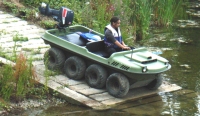 This 20 plus year old, eight wheel drive Argo is a wonder go anywhere vehicle. While it lacks design flair and is so flat that it looks as if something fell on it, we call it the "astounding Argo" because that is exactly our thoughts when we first saw what these amazing machines could do.
Our thanks to Christian from Norfolk for this one and for the absolutely amazing demonstration he gave. Adam spent more time flying in the air, hanging on for dear life than he ever did actually sitting in the back. It still has him waking at night screaming!
In fact, we have never come across a small machine quite like this that people climb aboard thinking of it as a toy and yet leave white faced and completely shocked by its amazing raw ability to climb, swoop, turn at 90 degrees or more on the spot, run along "V" shaped ditches and to cross anything put in its path including shrubs, mud, water, snow, ice and sand.
Made under licence by Crayford Motors, our model has a twin cylinder Kohler two stroke engine, the original carburettor having been replaced with an SU model.
Power from the engine is provided via a torque converter. Basically, a "V" shaped rubber band is pushed further up a "V" shaped groove as the engine revolutions increase, thus tightening it around the pulley to the gearbox and off it goes.
A very simple series of chains, tensioners and sprockets then distribute power to each wheel. Steering is by way of two hand levers, one of which has the twist grip throttle mounted on it. By pulling back on either one, it slams on an inboard disc brake on the relevant side, locking the wheels and the whole machine then skids off in the direction of the locked side - and we really mean it!
The balloon tyres are actually the only suspension system. However, with a set pressure of only 3psi, they provide unbelievable grip and very low ground pressures that can take these vehicles across almost anything.
Ribbed ridges on the tyres are the only thing that powers it along on the water. This is at a painfully slow pace, even with the engine screaming away. You are better off using an outboard motor for water use. The back of the eight wheel Argo is however so buoyant that unless you have a fair weight of ballast or two to three people, the outboard motor will not reach the water - so fill up on food and drink before you start!
Another word of warning. Take a long paddle. If the motor stops on open water and you do not have an outboard, these Argo things are total drag in the water and have no directional stability. If you need to use a paddle, you have to stand up; two swipes on one side and two on the other. I had to paddle ours for an hour and a half using a long branch with two plastic milk bottles tied to the bottom (no paddle) and it nearly killed me. If you do get into this position, just paddle as hard as possible and think of something else because you will go mad if you keep looking at the speed (or lack of it).
Do not be fooled - Adam had over 60 kilos of weights on the floor to keep this Argo level in the water plus the outboard motor, fuel tank and his own weight! If he had not, the propeller would have been out of the water.
Want info on ATVs? Try this link.
The Croco - Ugly But Gifted
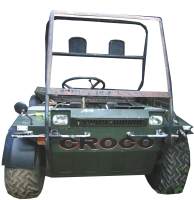 Pretty she ain't but amazingly gifted she is. The Croco amphibious vehicle will climb mountains and boulders where no other vehicle can go, before fording a lake with or without the optional propeller. So much so that the Swiss Army had a batch of these made to order from Germany in the 1980's.
These highly unusual vehicles are actually split in two. They have a back and a front section (tub) which although attached can rotate independently in the vertical plane via a huge fixed roller bearing in the centre. This means that one of the front wheels can go over something like a 60cm rock, while the opposite rear wheel can go over another rock of the same size! This is a truly amazing ability for a reasonably small vehicle.
The giant tyres provide enough traction to get this baby straight up a 45 degree (100%) slope, or sideways on a 40 degree (85%) slope, while carrying loads of up to half a ton or six people. This has to be seen to be believed. No wonder it has a huge roll bar - you would not want to get it wrong at these angles! Take a look at this really great website for the Croco.
The Croco has permanent 4WD and to avoid "wind up" of the axles, it cleverly avoids the problem by having the rear wheels duplicate the movement of the front wheels but in the opposite direction, so they travel exactly the same distance and this also gives it an amazing turning ability. "Wind up" is a condition where the wheels naturally try to turn at different speeds when going round a corner. With locked differentials they cannot do this. Normally in off road conditions the soft ground permits locked 4WD wheels to skid and skip to remove the "wind up" stress but on a hard surface they may not be able to do this and the built up stress will either bring the vehicle to a standstill or snap something.
For their sins, the passenger has a very hot, noisy air cooled rotary NSU-Wankel engine located directly under the passenger seat.
The only other vehicle that we know of remotely like this is the American Coot but as we have never seen one up close (none seem to be in the UK), we cannot compare the two. We have tried to contact the Coot website but cannot seem to get through.
Our Croco came from Scotland UK with only 18 hours on the clock and everything seized solid. It must have been stored for over twenty years from new! We have now eased the steering, pulled the engine and gearbox out and are chipping away the rust before cleaning and repainting the inside ready for fitting a spare engine and gearbox. We will probably get the original engine and gearbox working in due course - so if anyone is interested?
Everything has been kept so simple on this vehicle. Even the fuel is picked up by sticking the fuel pipe into the next can.
Try this link for an amazing video of what these machines can do.
If anyone has more info or stories about these vehicles please contact us.
The 'Kinder Egg Red Submarine'
A university degree project
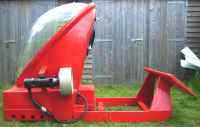 This superb exhibit from the UK is one of the most aesthetically exciting designs we have ever seen.
Designed and constructed by Alistair Cox around 1984 for his BSc (hons) university engineering degree, it displays some of the most unique style orientated design features of any of our exhibits and was built totally from scratch.
25mm thick Perspex for the impressively large front was donated but Alistair had to pay over £1,000.00 GBP to get it moulded to his design shape. The submarine itself is made from carbon fibre, with a design depth of 100 feet (30 metres). It did however have an impressive safety design factor that would have seen it able to safely descend to depths well below that.
The pilot unusually sits upright with a joystick to control movement - like in a helicopter. Alistair managed to obtain two 2.2KW thrusters from a deep sea ROV rated for a maximum depth of 1,000m (originally costing thousands of GBP each)! Power for the sub was from batteries located below the pilot's seat and a tail boom to provide control for the vertical axis.
The original design was for a second set of thrusters operating in the vertical axis but lack of sponsorship meant that no more thrusters were available and a tail boom was fitted instead.
However with the Perspex, thrusters and several other items, Alistair fared far better than most of our creative inventors in obtaining donations. Sadly, in the end he had to raid his student loan to fund the remaining items as time was running out for the degree course. Retiring to a tent in the corner of a field in Yorkshire for three months, he constructed the Kinder sub (our name not his) in the only workshop available to him - and what a great job he made.
The sub unfortunately never dived due to financial pressures and neither was the buoyancy system fitted. It is possible that the entry would have been on the impossible side too as the only way in is through a circular hatch in the back, which is fastened from the outside and requires the agility of a limbo dancer to get in and out!
However this was a really great attempt to get some design into a submarine and the lessons he learned involving design stresses and carbon fibre engineering were immense.
Remember, this is a prototype. You nearly always have to make one to know what the next should be like. Given time and money all these things would have been made to work. This is a fantastic source of inspiration for other engineering students thanks to Alistair.
Benson Amphibious Gyrocopter
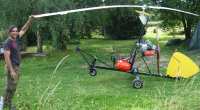 The Benson Gyrocopter from the 1970's was one of the first mass production gyrocopters and came with an amphibious version. It came as a kit or a set of plans. Using a second small motor at the masthead to turn the rotor, it could be snatched off the water when the blades were revolving fast enough but woe betide you if you did not have enough forward speed on by that time to keep them turning and stalled out!
Our gyrocopter was built in the UK. When we got it, much was missing but it did come with a huge box of spare parts, wheels, aluminium tubing and engine bits. Our thanks to Guy for this one. He and some other RAF chaps were going to complete it but time and overseas postings got in the way. That was probably just as well because when we tried the new pistons in the engine, the heads were too deep and the engine could not turn!
He had got it in 2001 as a partly completed machine. As far as we know, it was never flown under engine power but things we have seen indicate that it might have taken to the air towed behind a car at some time before it was upgraded by having an engine fitted.
The motor looks like an old air-cooled VW Beetle 1600cc that was rebored to 1800cc. The work having stopped at that point and hence the box of spares.
The kits and plans for these Benson gyrocopters came in several stages to permit owners to upgrade as time and money became available. The plans even showing someone apparently casually driving one along the road!
Our model has the special second motor masthead attachment but no floats yet - but it will soon have!
Due to the difficulties of getting airworthiness certificates for such an old machine, this will not fly but remain as a superb heart stopping exhibit. Adam Soloman has made a great restoration of this gyrocopter for us including a brilliant paint job.
Gyrocopters fly by the propeller at the back pushing the machine forward at speed. Before starting, the pilot reaches up and starts the twin blade rotor turning and as the speed builds up, it spins faster and faster, each blade having a lifting aerofoil profile. When turning fast enough, they are tilted to give lift and up she goes.
They can land almost vertically and have an amazing short field take off - especially if they have the small masthead motor fitted. On some models (including this one) there is a pulley from the engine that could be used with a crude clutch and rubber belt to turn the rotors for starting instead of the pilot spinning them.
Gyrocopters cannot hover like a helicopter as they need the forward speed to fly. Unlike a helicopter however, they can fly slow and low to the ground without stirring up a huge cloud of dust. Some claim this should make them an ideal covert insertion craft. James Bond used a gyrocopter code named "Little Nellie" in the film "You Only Live Twice".
The Australian Shark Submarine
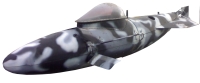 What can we say about this fantastic looking thought submarine we have christened "The Shark" which comes to us in the UK all the way from Australia?
Well the answer is not much at the moment - because it has just been delivered in this giant packing case and it's raining! We can say however that it is much more complex in its build than we had first thought and will find out more over the next week when (if) it stops raining!
Come on all you guys and girls from Melbourne Australia, we need to know more about this sub, who made it and when - give us a lead and contact us.
Our thanks to Graham for this one. Found by him in a Melbourne scrapyard around 1990, this was once someone's dream and passion. Who was that? If you know, please contact us.
Bought from the scrapyard to show on a pole for business advertising, it never actually got there and has sat under cover ever since.
This shallow diving submarine was made from the drop tank of an F/86 Sabre and still has the ID plate on it to prove it! A 24 volt system with batteries is set in the nose and an open section in the back (possibly for inflating tanks). It comes complete with a snorkel for shallow cruising.
The amazing 'The Hoverhawk HA5'
Production of these hovercraft commenced in 1967 by Hover Air in Peterborough UK on what was the first ever mass produced commercial two-seat hovercraft. Of its time, they came complete with futuristic gull wing doors, two rotary engines for thrust and another for lift. This combination together with the twin rudders made for one of the most manoeuvrable hovercraft ever built, even by today's standards.
.jpg) A total of 121 Hoverhawks were produced between 1967 and 1971, making this a large production run for something of such a unique ability.
A total of 121 Hoverhawks were produced between 1967 and 1971, making this a large production run for something of such a unique ability.
Sold to many countries for a very wide range of uses, including predictably the Army, Navy and Coastguards, as well as many other private leisure and commercial sales, many of the survivors have been tracked down over the years by Warwick Jacobs of the Hovercraft Museum. They have the largest collection of these rare survivors in the world and are an amazing place to visit for any hovernauts!
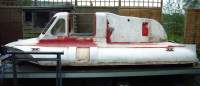
Our Hoverhawk Mk 3 is number 113. It was used by the factory as a demonstrator and was sold off in 1971 when the company went bust. It travelled to Flambards Amusement Park in Cornwall as a static display item. It remained there for many years before being sold off to an enthusiast who cut the back off to fit a bigger engine.
Two more changes of ownership and we managed to acquire it for the collection. The advertised "just a bit of rubbing down before painting" has so far turned into over two months of full time grinding out of the thousands of "crow's feet" cracks in the fibreglass and re gel-coating. The engines have all been reconditioned and soon we will begin the repainting and rebuilding. Our aim is to achieve the best looking restored Hoverhawk in the world!
The most exciting event in Hoverhawk history was when Sir Ranulph Fiennes used two early Hoverhawks, nicknamed Baker and Burton, to journey up the "White Nile" in 1969. Baker unfortunately fell off a lorry whilst being transported and fell down a cliff. The remains were left with the district commissioner of a place called Bor to scare hippos away from his garden plot! Burton completed the journey. The story is particularly fascinating for its description of the various operating conditions they met and how they affect hovercraft performance.
Hovercraft travel faster over hard flat surfaces like sand or dirt than over water or grass. This can become critical when transitioning from one surface to another. Travelling fast from land onto water without slowing down can lead to the hovercraft "pitching in". Travelling from water to dry land can lead to the reverse, as the hovercraft will speed up. Several people have ended up in the car park by accident instead of stopping on the ramp when they came out without slowing down!
 On water, the air from below the skirt blows a depression into the water surface. When the hovercraft tries to move forward, it has to get out of this depression and this is called "getting over the hump". Once it is over the hump, it can travel faster for less power. Our Hoverhawk Mk 3 can travel at 45 mph (75 km) on land and 35 mph (58 km) on water.
Hovercraft have no contact with the ground and in order to turn they have to direct thrust from their fans in the opposite direction to that in which they want to go. If they need to stop in a hurry, they have to completely spin around in the air until they are facing in the opposite direction to that in which they are travelling and then apply full thrust.
Stopping on land is carried out by reducing lift until the skirt touches the ground, slowing the Hoverhawk down and then rapidly dumping the lift via special dump valves. The Hoverhawk has a separate engine for thrust and is therefore more controllable in this respect than a hovercraft with only one engine for lift and thrust. An early mistake commonly made when beginning to learn in a single engine hovercraft is to pull back on the throttle when needing an emergency stop. This also stops the lift and they can hit the ground and turn right over.
Try the Hovercraft Club of Great Britain for more information on events and handling. If there are other clubs out there that would like a reciprocal link then contact us.
The Beatles Yellow Submarine
Is this the Beatles only 'real' Yellow Submarine in the World?
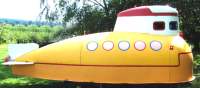 A real Beatles Yellow Submarine. Beatles fans everywhere will be keen to see this.
We understand that this crazy big fibreglass submarine shell was produced at Elstree Film Studio in the UK and used for the launch of the electronically remastered Beatles CD music in the 1990's. We are unaware of any other real Beatles Yellow Submarine prop in the world associated with a real Beatles production.
Purchased by us from the "Cars of the Stars" museum, it had taken pride of place at their Edinburgh (UK) Highland Showground for many years before the museum was closed.
Can any Beatles fan or anyone who worked at the Elstree studio let us know more of its history please? Contact us.
This is not a true submarine but something to inspire and that is why we have it in the collection. The fibreglass shell comes complete with conning tower, pop up top, internal steps and a heavy box section internal steel frame with small scaffold tower wheels to move it about. The submarine originally had a blue flexible skirt clamped around the bottom moulding to hide the wheels and one is in the process of being made up to take its place.
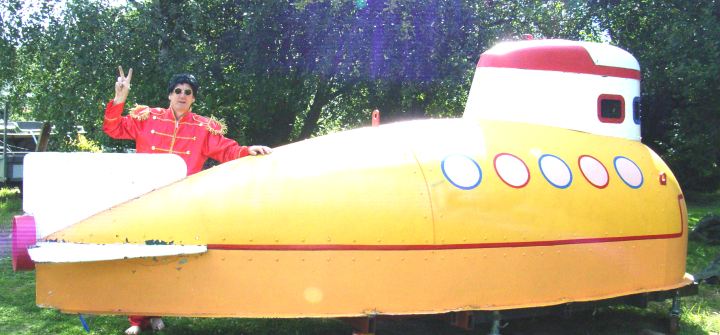
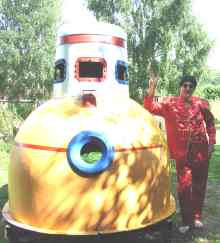
To get inside, you just roll under the back (well we do)! There is no door anywhere but once inside, the top opens and there is a hole in the nose and windows to see out.
Painted yellow all over, it has portholes painted on one side only for filming. There are compressed air tubs on the front and back of the conning tower that might have operated a periscope and something else - perhaps someone can show us a photo to enable us to completely restore this unique Beatles exhibit.
It is now available for event hire - contact us for details.
The 'Wernicke Flying Car'
FLYING CARS - the dream of any driver stuck in a traffic jam and all sane pilots facing a dark and lowering sky.
Wacky inventors by the crate load have tried to design them, a few have actually built them and some have died trying to fly them. Yet despite all our modern technology, the production of a practical, safe and affordable flying car is still remote.
The main challenge is that almost everything you want in a road vehicle is the exact opposite to that required for a successful airplane. Cars need weight to stay on the road, they feature heavy, complex gearboxes and large wheels, with the designers avoiding aerodynamic lifting profiles like the plague and actually designing downwards thrusting profiles to make a car heavier the faster it goes.
Airplane designers conversely shed surplus weight from their designs with a fanaticism that has to be seen, don't include complex gearboxes and use only small wheels to save weight and drag. The wings and body shape profiles of an airplane are also at every turn designed to provide maximum lift and these are just some of the issues that arise without taking into account that normal wings are just far too wide to travel on roads.
Many years ago, imaginative and airplane mad eleven-year-old Kenneth Wernicke from Texas dreamed of making a flying car. As happens in life however, other pressures soon crowded in to smother the inventive young dream of achieving the impossible. Years of study, a career in helicopter rotor head design and the responsibilities of raising a young family all took their own priority. In the process the dream was forgotten - or was it?
Years later, driving down the freeway with his own eleven year old son beside him, this remarkable engineer suddenly recalled his dream. As the length of the journey grew, so did his determination. This time he knew that whatever it took, he would follow that forgotten eleven-year-old's dream from way back. To our benefit, so was born the unique Sky Technologies "AirCar" (SkyCar).
Examination of existing designs showed that almost every attempt relied on long, thin conventional wings. These not only give rise to the perpetual problem of "where can you land safely" with such a wide wingspan but also what to do with the wings when landed. This is particularly important as most people's idea of a flying car is to be able to take off and land almost anywhere you want to, or might be forced to in bad weather.
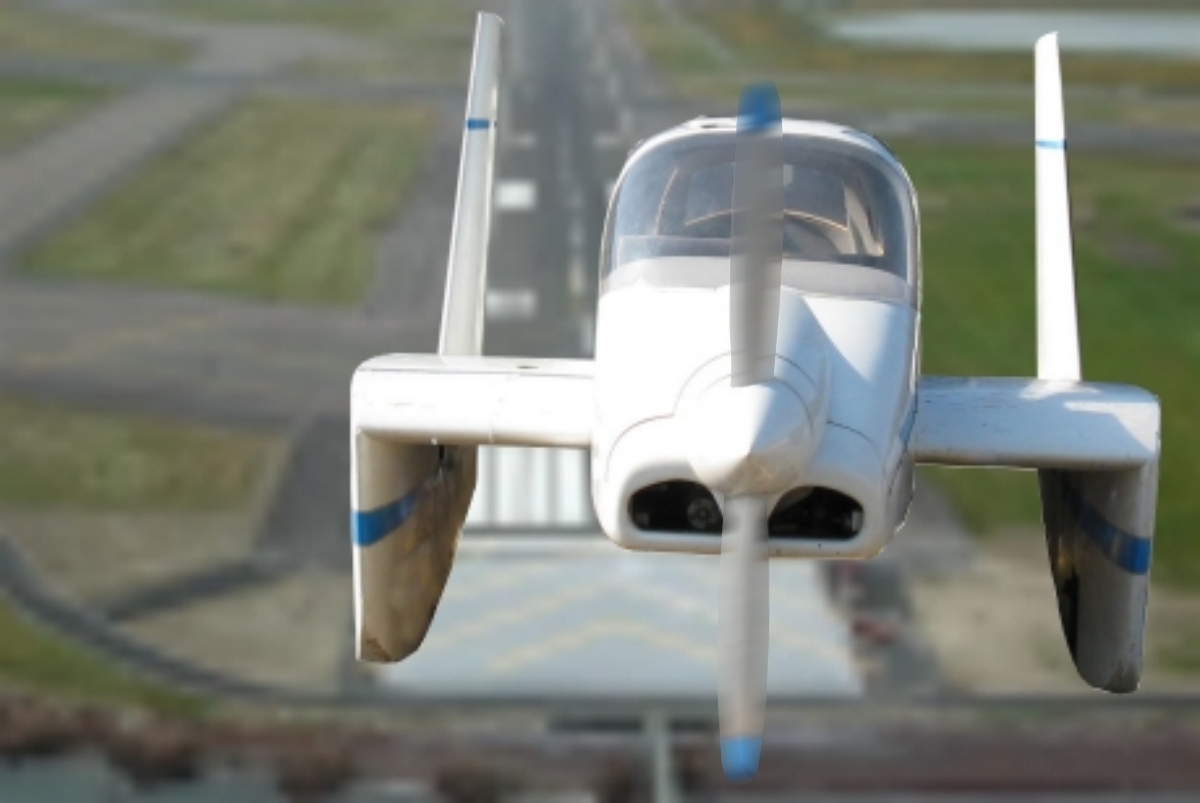
Some designs fold the wings up over the top like an elaborate ladies hairstyle, some take them off to drag behind like a trailer and yet others unbolt the car and leave the wings at the airport. All are complex and delicate procedures with varying degrees of success.
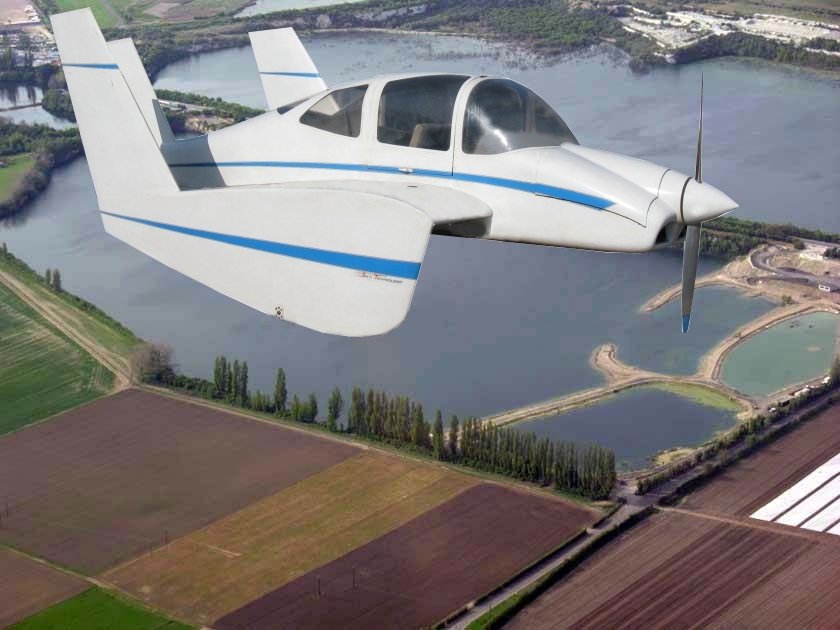
Enter Ken Wernicke with a uniquely imaginative approach, rooted in his vast knowledge of the characteristics of flight. He realised that conventional long, thin wings were not the only way to obtain lift. You could alternatively (please forgive me Ken but most will understand this description) have short fat ones. Both will provide the lift you need but each has its own characteristics. The breadth and depth of a wing are referred to as the "aspect ratio".
He reasoned that if by using this type of short wing design a flying car with a fixed wing could be constructed to fit into a parking space, at a stroke the problems of where to land and what to do with the wings would be overcome. It would simply drive on the road in the same configuration as it flew.
The gearbox problem he solved by fitting a specialised hydraulic system to power the propeller or the road wheels by moving just one lever. The overall solution being far less complicated, more reliable and considerably lighter than having two gearboxes.
This left the design of a highly unusual wing. With little research available for this type of design, Ken progressed from model to model, testing and improving the design as he went. Many hours of wind tunnel tests, recalculation and new wing profiles led ultimately to a one third scale flying model fitted with video cameras to monitor the flight characteristics from a screen on the ground, thus enabling a pilot's eye view.
Short wings have several performance characteristics peculiar to them, one being that they are naturally unstable in roll. Everyone will remember the "Red Baron's" Fokker Triplane of WW1, specially designed with three short wings in order to produce a highly manoeuvrable (if sensitive to fly) fighter plane.
One of the reasons for the instability is that air flowing over short wings constantly tries to escape off the ends rather than smoothly flowing over them. To beat this problem, Ken cleverly developed the large drooping winglet design below and the twin tails above to counter the problem of rocking and instability. The winglets have the additional benefit of streamlining the undercarriage and wheels at the same time.
The second characteristic of this wing design is high levels of drag. Things like this are treated as facts to be taken into consideration rather than problems in themselves when working with such specialised design criteria.
In this case, whilst there might be a slightly higher fuel consumption, the main design consideration is that if the wing were to stall at heights below 500 feet, it could prove impossible to regain flying speed.
 Ken believed that he had the answer to this problem and so the AirCar prototype was built to obtain funding. It is no mock up but the actual thing that working models and kits would have been taken from, with a superb quality of build.
Aviation authorities have always expressed a fear of being inundated with inexperienced flying car drivers zooming around and crashing everywhere. Highway authorities are also wary of drivers trying to take off and land on their roadways at high speeds. Because of these issues, it is likely therefore that however good any flying car design might prove to be, regulatory barriers would simply be raised if there were ever to become a serious possibility of mass production.
When potential financiers become aware of this, the possibilities of obtaining commercial finance for production dry up.
Lack of funding has alas proved the ultimate barrier that so far prevents production of the unique, creative and highly professional AirCar design, despite Ken having conquered every design challenge. This leaves production hopeful only if James Bond or the military become sufficiently interested.
We believe the AirCar to be one of the finest, most inspirational and practical designs of flying car ever produced and for this we have to thank that eleven-year-old Kenneth Wernicke of Texas. Long may the youngsters of today follow his example and take their dreams of today into tomorrow.
Research into the AirCar gave rise to several technical engineering papers, making in the process a unique contribution to the technology and performance characteristics of this type of wing. Papers 942156 and 975603 are available from SAE International (The Society for Advancing Mobility Land Sea Air and Space).
- Design speed on land 55 mph
- Design air speed - engine as prototype 216 mph
- Design flight duration - 2 people 720 miles
- Stall 70 mph
- Takeoff distance 500/750 ft
- Gross weight 1,400 lbs
- Fuel load 40 gallons
- Wing loading 15 lbs/sq ft
- Amphibious Option Available
It is said that you can't keep a good inventor down and certainly in this case Ken Wernicke and his son Keith Wernicke have gone on to design many unique things, with their latest project being the amphibious all terrain "Fastrack". This is a unique high-speed tracked machine that travels on land and passes seamlessly onto water at amazing speeds.
Our gratitude for the unique AirCar forming part of our collection goes to Ken Wernicke himself, Keith Wernicke and everyone at the Frontiers of Flight Museum in Dallas, Texas, who generously passed it on to us from their own amazing historic flight collection. Find out about them at www.flightmuseum.com
The amazing 'Toymakers DUCKW'
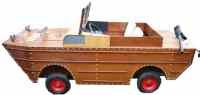 An exquisitely constructed mini DUCKW (sort of) made from beautifully varnished light timber and plywood with full on land and water ability.
Our thanks to the McCue Family for this one. Found in a famous toy auction house at Stockton on Tees, this "one off" crazy piece of amphibious invention came complete with an electric outboard motor to provide drive on the water and full steering and leaf spring suspension for the land part of the operation.
A folding windscreen, one blue and one yellow headlight plus some fascinating parts from an old refrigerator (I think) on the front deck add style and two tip forward adult sized seats all go to complete this beautifully designed and built vehicle.
Sadly, it had no method of drive on land other than push along manpower. Brakes were not an option either - that's right, the slipway was a case of wheee-splash!
We have absolutely no idea who built this vehicle or why but would be fascinated to find out. A lot of creative design, care and love went into it. So if anyone knows - please contact us. Every youngster we have shown it to has absolutely loved this machine. It has proved to be such a fun little vehicle that we could not leave it alone.
In most cases, we do not alter what the inventor has made but we just knew when looking at this one that the creator had really wanted to make it drive on land and sea but whilst having been an amazing woodworker, they had lacked the skill to do the mechanical parts.
So we put our heads together with world famous Belgian inventor Rene Baldewijns and his projects manager Katty Vermeulen, constructors of the world's only drivable submarine - the "Amfibidiver". The "Toymakers DUCKW" took a trip over to Belgium.
Rene tests this sort of thing in a plastic inflatable swimming pool, having to drive things up a ramp of wood balanced on barrels until they plop into the water - an amazing act of invention in itself!
A buoyancy test found leaks around the steering gear and showed up balance as a real potential problem. If one person is heavier than the other, or there is only one person, it leant well over to the heavy side.
Providing balance
No problem. Rene built a carrying rack for the two big batteries and formed a track going from side to side under the seats. A bicycle chain, electric motor, small wheels for the rack, some wiring, two push buttons and electrical gizmos later and he had produced a highly effective system whereby pressing one button or the other, the tray with the batteries simply slides across to act as a counterbalance.
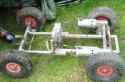 Providing drive on land and water - a really clever bit! To do this, Rene took two motors from a miniature electric kart, complete with electrical gizmos, a computer joystick, the light control slider from an old photocopier, some bicycle gears, bicycle chains, an on/off switch and another for forward and reverse. A very neat bit of welding using two "J" shaped roofing bolts made a clever chain tensioning system to complete the kit.
He decided on an independent drive to each rear wheel via the chains for reasons that will soon become clear. One motor was geared to each rear wheel with the controller operating both motors in forward or reverse at the same time. The suspension to the rear wheels was done away with due to the need to tension the chains. If it had been left, every time the DUCKW went over a bump, the chain would come off!
Providing drive on water. Ingenious is the word to use. Reverting back to ages old technology, Rene designed paddle wheels to run in side boxes. The drive to these is provided by a spring loaded clutch at the end of each axle. Turn the clutch head and it springs forward to engage three pins into the end of the axle and the paddle wheel then turns with the car wheel on either left or right.
Turning on the water. Ahhh, that is where the computer joystick comes in handy. By flipping a switch, each electric motor now becomes independently driven. They can be driven in reverse or forwards simply by using the joystick - just like space invaders! This is actually a highly effective design with a fairly short vehicle like this and it can turn on the spot! The photocopier light control? Well I thought it was obvious - Rene has used it as a speed controller. It's a bit weird to operate but like most things Rene invents, it does the job pretty well.
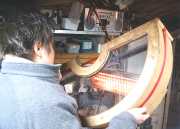
Katty dries the varnish to keep warm. Katty had to endure some sub zero days working during the winter. We have a photo of her sitting on the cold concrete floor in front of an electric fire and either trying to get warm or trying to get the varnish to dry - now that's dedication for you.
The finished product? Well they could be excused for having just put the bits together and left it alone when it all worked. Instead, they went on to produce a beautiful pair of timber paddle wheels and side boxes, complete with moulded cut outs with clear plastic inserts through which you can see the wheels thrashing the water.
.jpg) On land and water? - It goes like a bomb! A great success and a huge big thank you yet again to Rene and Katty - oh yes, and to Rene's two children who acted as test pilots for the water bit!
On land and water? - It goes like a bomb! A great success and a huge big thank you yet again to Rene and Katty - oh yes, and to Rene's two children who acted as test pilots for the water bit!
We would like to hope that the original maker of this great little machine will one day be able to visit it at the museum (when located) and see the improvements we have made. We are sure that whoever it was will be really pleased. Enjoy.
Dutton Commander
Joint world record holder
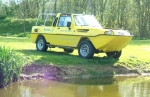 The "Dutton Commander". A four wheel drive amphibious car, fully road legal and made in 2002.
Produced at the Dutton factory, Littlehampton in the UK, Tim Dutton continues to be either the only civil manufacturer of road legal amphibious cars or one of the very few. This highly driven and amazingly creative engineer simply keeps going as others try and fail.
Tim commenced producing custom cars in 1969, rapidly cornering a large part of the kit car market, where his huge creative drive and dreams led him to design and produce over 22 different models as well as designing many special vehicles for others. His production output being well over 8,000 vehicles - not much for Ford perhaps but amazing for a custom car producer.
He first considered making an amphibian in 1987 but work was shelved. It was however to this dream he returned after his main car making business was sold; production commencing in 1995. He currently produces up to 20 complete cars per year plus kits, under the new "Amphijeep" name for kits and "Dutton Commander" for complete vehicles.
Our vehicle has a 1.9 litre diesel engine, a two wheel drive high or four wheel drive high or low gear ratios, plus freewheeling but lockable front hubs. It uses a customised power take off clutch for the single impeller, which is basically a multi bladed propeller running inside a tunnel. The final compressed water jet leads to greater efficiency.
The "Dutton Commander" is a highly versatile fun vehicle with basic trim. It has a top speed of around 85 miles per hour on land and 6 mph on the water. It performs utterly convincingly as a jeep and as a boat but for sheer fantastic novelty, the run into and out of the water in any amphibian cannot be beaten.
Tim claims not to have studied other amphibians during the design phase, relying instead on his own intuition, creativity and extensive experience of cars and motor boats. The result is several design features which in an understated way avoid many traditional amphibian design problems and permit a road legal vehicle. The use of a purpose made fibreglass hull combined with careful design means that no holes other than the two completely watertight holes for the drive shafts pass through the body in any underwater area. The fibreglass means no structural or body corrosion and avoidance of the usual rubber waterproofing boots around the moving axles and steering arms means no constant weeping of highly corrosive salt water into the vehicle, therefore lowering the possibility of corrosion problems for internal body seams and components.
Cooling of engines is always a problem for amphibians as they have no natural ventilation. Many try to resolve this with a large vent over the top of the engine compartment such as on the Amphicar and indeed on our mystery Citroen. For obvious reasons, this is not a good idea in heavy rain or a splashy sea. In the Dutton Commander and our "Red Aquaterra", air inlets duct the air through body panels and over the engine, the Dutton having additional intercooler pipes below the hull for when on the water.
Other design features include the bends in the exhaust to keep water out, the tiny but amazingly efficient "full time" rudder, and venting of the axles to prevent "axle suck"; a condition where hot axles are driven into cold water causing the air inside the axle to contract and suck in water - not good!
Our vehicle has been used for construction survey work and water testing on a large bird reserve lake.
When examining custom car making, one soon realises the vast amount of hard won practical and technical knowledge a designer requires - especially if they keep producing different types of vehicles. They need to be a creative designer, draftsman, engineer, have advanced knowledge of accurate car body mould making, a comprehensive understanding of how different mechanical systems work and which will be most suitable for the project in hand. This is on top of a thorough knowledge of the road legal design requirements of several countries.
Sudden changes can also be forced on a custom car maker due to changing legal requirements or the manufacturer of the donor vehicle changing specifications just after the car body has been moulded. A classic example being the recent demise of the Suzuki Samurai model, meaning a complete ground up redesign of all the moulds for the Dutton Amphijeep and Commander models.
Miniature Submarine
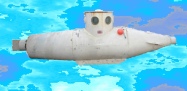 Recently acquired - we have a one man miniature submarine!
This was apparently built by a marine engineer to his own design and after having researched the subject for around two years.
It was apparently tested and used in and around the Plymouth Bay area UK, where it was dived to depths of around 17 metres.
Beautifully and professionally constructed of galvanised steel, it has an electric motor powered propeller, joystick operated rudder and screw driven hydrovanes.
Diving is controlled by buoyancy tanks back and front into which water is permitted by opening valves and driven out for surfacing with compressed air tanks, which are located under the seat. It has a headlight on the front for spotting whales and treasure hunting with lots of windows in the conning tower to see out of and even one in the top hatch!
The chap we got this from had lost the name and telephone number of its creator and if he sees this, or someone else knows where he is, we would love to hear about its origination, construction and testing as this is a great dream, fits well into our exhibits and kids are going to be madly inspired by it.
Trippel Aquaterra
From the German 'Father of Amphibians'
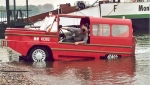 An amphibious car of real historical importance due to the place in its designer's history.
Constructed to the design of Hans Trippel from Germany in 1989 when he was 82 years old. This was his last but one amphibian design after a lifetime dedicated to amphibian design and construction and in which he is credited with having been influential in the design or construction of well over thirty different types of amphibious vehicles, many of which reached production. This includes the prototypes for the world famous "Amphicar" of the 1960's and easily justifying him for the title "father of amphibious cars" if there ever was one.
Hans was actually jailed after the Second World War for the part he played in making amphibious vehicles and banned from making them for some years after his release.
Hans Trippel raced cars as a young man. Being not so good at it, in 1934 he converted his racing car into an amphibian, presumably at least then he was faster on water than the rest. This is typical behaviour of many creative inventors: blocked in one direction they simply spark out in another, often with amazing results.
The Red Aquaterra is based on an Opel Vectra running gear and engine. It is a highly impressive fully working amphibian in its own right and although it breaks no obvious new mechanical ground, with its immense sliding doors and capacious interior, it is almost a cross between a military style jeep size and a family car, as well it may be given its pedigree!
It has a three bladed propeller driven by the four wheel drive transfer box position but this unfortunately means drive to the wheels remains only two wheel drive. Hans Trippel toured to several shows in Germany with this car, seeking orders but it was just not sufficiently developed or polished to attract any orders. Hans seems to have been more an inspiring visionary than a good nuts and bolts man and we understand cars were generally built to sketches and not to detailed drawings, rather relying on the skills of the mechanic of the time to try to make it work. This emphasises the point that the drive and energy of creative dreamers working with little knowledge of many aspects can often be responsible for major new innovations, even if those dreams have finally to be produced by others better equipped to do so - it takes all sorts - so never be worried about having a go.
Whilst on loan to a friend, the friend forgot to put the bilge plug in. Unfortunately, even after a lifetime of amphibian design, Hans had not specified an automatic bilge pump that would start as soon as the water level rises. The result was a diving Red Aquaterra which lay in 7 metres of water for almost two days before divers found it and got it out. After two days drying out, it started straight away.
I wonder what a fly on the wall would have heard when he told the guy he'd just sunk the car!
The 'Yellow Submarine'
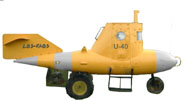 A huge favourite and inspiration for kids of all ages!
We were lucky enough to obtain this vehicle from a public events company in Sussex, who had built it as a spatial disorientation vehicle for team building games. At just over 5 metres long, this is one of our most portable and entertaining exhibits. In great demand for both internal and external functions and educational experiences of all kinds.
History
Originally a submersible side scanning sonar towed behind a Royal Naval Frigate, the events company turned it upside down and added the conning tower, back axle from a Suzuki van, front wheel steering from a Land Rover and the front wheel from a Mini. Power was provided via a Honda stationary engine to drive the rear axle via a chain drive and Suzuki high/low ratio gearbox.
Because this is one of the most in demand exhibits, we have converted it to electric power for safety. This has been carried out using the rear axle, speed controller and motor from a golf buggy. We have also added the side door, portholes, music player and flag masts and flashing lights. Considerable technological issues are faced when chopping and adding motors and gearing ratios including power consumption, battery type, charging rates etc. Very little of this information is off the shelf.
We would not normally customise exhibits this way but the "yellow submarine" is more a super imagination grabbing visual ambassador for the museum than a truly amphibious vehicle. Having said this, it did come with a guarantee that it would reach depths exceeding 5,000 metres! Spotted the catch - yes; no guarantee that it would come up again!
It is however hugely inspirational and its continued development lessons reflect much of the mechanical and inspirational resourcefulness shown by many of our other exhibits.
The 'Mystery Citroen'
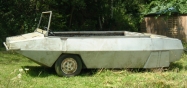 An amphibious car of real historical and engineering importance.
Rescued from a field in North Wales, this vehicle had been completely stripped of almost every working component other than partial running gear and remnants of a hydropneumatic suspension system from a Citroen "DS".
Unfortunately, the removed parts were lost. It is believed to be the only ever incorporation of this unique suspension system into an amphibian. It would have been used to achieve a high ground clearance when on land and a wheel retracting system when on the water for greater speed. The unusual flaps over the rear wheels were another obvious attempt to streamline the body in water.
History
Local newspaper appeals for information relating to this amphibian received many replies. It was used to get to and from "Castle Island", located in the "Menai Strait", a tidal river separating North Wales from the Isle of Anglesea.
The five stud wheels were not in production before 1965 and the amphibian was seen in use in 1966, so we have an accurate location and date of construction and use. It is also thought to have been owned by the Ferranti family, a name famous in the advanced electronics business. They also had a flying boat, a large car collection and houses in France, Ireland and Italy.
What we have yet to find out is where was it made and by who?
The superb purpose built aluminium body, accurate internal chassis, rear mounted engine, propeller take off, streamlined rear wheel covers, possible four wheel drive and the hydropneumatic suspension on top of that make this a product of very high design and engineering skill. We can only see one area of alteration, so it went together almost exactly as designed - an unusual situation for a prototype!
One witness believes it was the French Citroen answer to the German "Amphicar". The parts used are however believed to be from a UK model Citroen, but the Citroen head engineer at that time knows nothing about it.
We are preparing to restore this vehicle to working order in the near future. Any help anyone can provide us with relating to the makers or designers of this superb vehicle would be very welcome.
As you can see, we had problems with the donor Citroen for restoration taking to water in our lake before we were ready for it!
The 'Amfibidiver'
The world's only drivable submarine
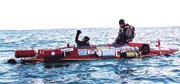 A twin seat machine that drives on land, floats like a boat and dives like a submarine.
The motto and the quest: "Riding, Floating, Diving"
Imagine a superb "film quality" exhibit of a futuristic, shark like underwater travel machine coupled with novel but practical engineering methods of pressurization, stabilization and the ability to drive on land and you have the Amfibidiver.
We defy anyone to look at this machine without their heart rate going up!
History
 Superb is the only description for the incredible high quality of concept, design and engineering that make up the Amfibidiver. This is a "must see" for anyone interested in engineering for the lessons it can teach.
The Amfibidiver is a very portable machine and can display as an attention grabber at events or as an impressive inspirational learning tool for schools and colleges etc. A series of educational sessions are being prepared based on the Amfibidiver ranging from underwater design considerations to prototype design concepts, construction and alterations. We have been provided with a beautiful record of its construction story including many clips from newspaper articles. It has been displayed at several boat shows in Belgium and on television.
For exceptional events, or film opportunities, its inventor may also be available.
The brain child, dream and workmanship of self taught engineer, inventor and adventurer René Baldewijns from Belgium. René has many hair raising adventures in small boats to his credit. He spent several years dreaming up and designing the Amfibidiver and a year constructing and testing it. He has a small team of interested helpers who follow his amazing adventures including Katty Vermeulen, who was project manager for the Amfibidiver.
René says it is simple. Just take one dream, the fuel tank of an airplane, two bicycles, the motors from five electric wheelchairs, the hull of a sailing boat, seven drink containers (a real justification for that empty bottle collection), several kilos of resin, a few garden seats and several miles of electrical cables. Mix it up with a year's work without pay, some incredibly dangerous testing work, enthusiasm, total dedication, utter exhaustion and many sleepless nights and you have one Amfibidiver!
So there you are fellow inventors - get to it. If you can create anything half as good as the Amfibidiver you will have a masterpiece of engineering to be proud of.